Listening – TED talk
 on on on on on
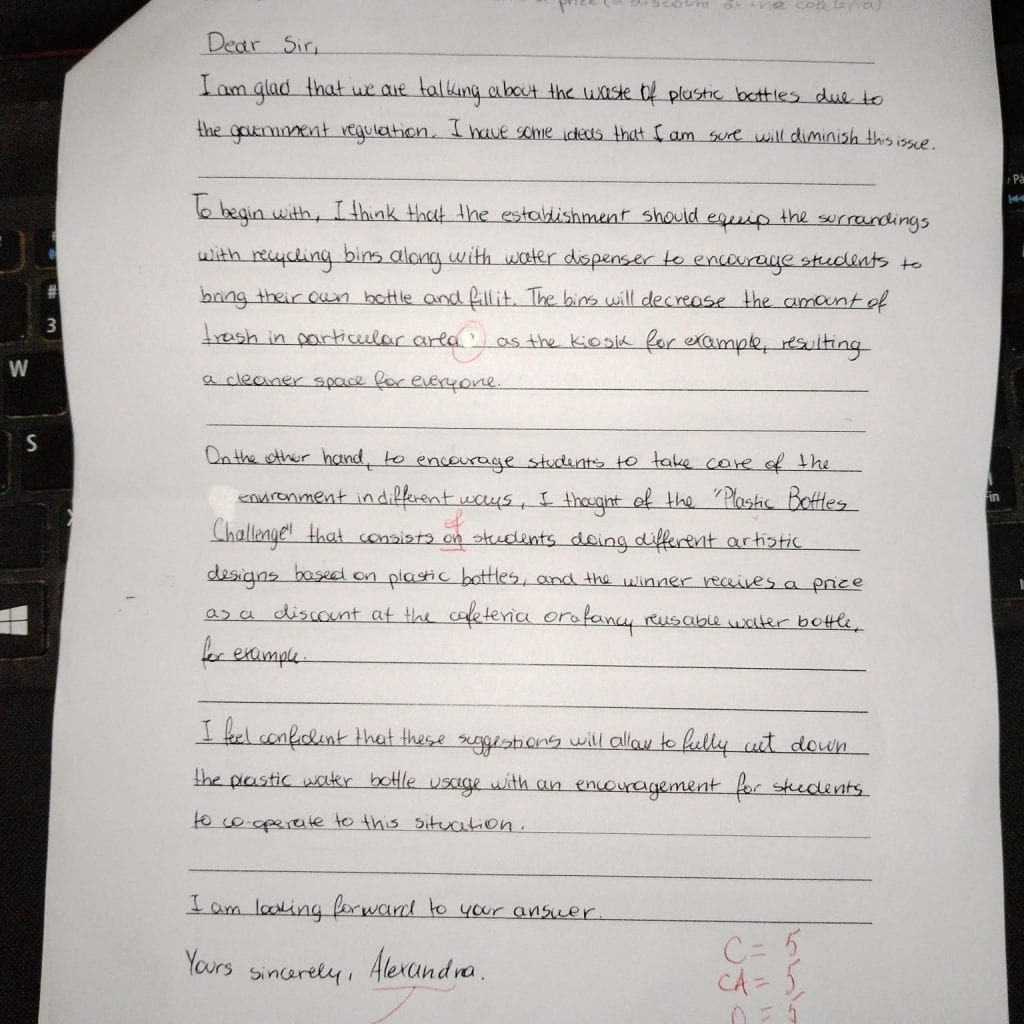
 Dear Sir,
I am glad that we are talking about the waste of plastic bottles due to the gouemment regulation. I have some ideas that I am sure will diminish this issue.
To begin with, I think that the establishment should equip the surrandings with recycling bins along with water dispenser to encourage students to bring their own bottle and fill it. The bins will decrease the amount of trash in particular areas as the kiosk for example, resulting a cleaner space for everyone.
On the other hand, to encourage students to take care of the environment in different ways, I thought of the “Plastic Bottles Challenge” that consists of students doing different artistic designs based on plastic bottles, and the winner receives a prize as a discount at the cafeteria or a fancy reusable water bottle, for example.
I feel confident that these suggestions will allow to fully cut down the plastic water bottle usage with an encouragement for students to co-operate to this situtation.
I am looking forward to your answer.
Yours sincerely,
Alexandra.
 on on
on on Wealth inequality: https://voca.ro/11bB73EZD3pP
Improvement plan for Chile: https://voca.ro/1iV42PGZMVr4
Respect: https://voca.ro/13SjSnxvXxAm
Appearance Judgement: https://voca.ro/1jIPN9X2yuuq
on Welcome to my self-assessment 4.
I can’t help but to say how fast the time passes. I can’t believe we’re almost finishing our second year, and the next one we will be doing our practice which makes me nervous.
This semester was especially hard for me, and not only because of my brain failing at the wrong time, but also because of the content. Intonation was so tricky! At first I couldn’t get any of the topic, but I finally understood it when actually speaking and applying it, but yet, it’s still confusing sometimes. Anyways, intonation helped me understand how important it is for us to use the right tone since in English it has many meanings, and we can be misunderstood just by using the wrong intonation.

Now, talking about my performance… This semester wasn’t really good because of life situations, but I still tried to do my best. Still, I failed to upload some homeworks but I have my personal reasons, jajan’t. BUT I know it’ll be better in the coming one’s.
Finally, Phonetics was a HUGE roller coaster that got me from losing my mind to loving the class, but I’ll keep improving my skills.
I hope you have enjoyed reading this, bye!:)
on Questions
on on From the very beginning I wasn’t really sure about this class because I did not know what to expect from it. When we eventually got into the topic, and started learning the importance of the proper use of technology, Ed-tech,some models, and more, I got interested as I noticed that this class will help us as teachers to know when, and how to use technology since there are teachers that basically leave the whole job to it when it’s not supposed to be like that. Mostly nowadays that tech is something that’s part of our lives already, but we have to know where the limits are.
Moving on, when learning about TPACK, SAMR and reading the texts that Mrs. James provided us with, I started to relate it to some teaching methods that will help me to develop a better class for my students using technology, but not always if it’s not necessary. I liked learning about these two models and when is best to use depending on the situation, and because of this I tried imagining myself doing a class applying these models separately, this is something I like doing as it gives me a calm sense to (kind of) know what to do already.
Finally, the presentation was definitely my favorite part. Learning about my own topic (Adaptive Learning Technology) gave me a wide amount of information that caught my attention quickly, so learning about it was not hard at all since I spent 3 hours straight just investigating, and when I realized I was reading about neurodivergence and how ALT could assist some teaching methods for those who learn differently. I liked presenting and talking about this, I could’ve given so much more information for half an hour but sadly I only had between 7 and 10 minutes to talk about it.
This was a class that opened up my mind to new possibilities when teaching, and made me understand that technology is not always the key, sometimes it could even be useless, and doesn’t even help with the learning process. However to avoid this we have to know how to use it properly, and this class gave me the answer to it.